Wednesday, December 23, 2015

New Riverside Park planned for Plain of Jars

Xieng Khouang province will develop a 10-hectare riverside park in Paek district of Phonsavanh to beautify the area and give residents and tourists a place to relax.
Vientiane Times reported the park is being built along the Nam Ngum River near a market and is on a well-traveled route that visitors must take to enter or exit the town.
It will take two years to complete the park. However, once it's finished, the place should become a popular spot where residents can exercise or join in community activities.
“Construction of the park is expected to be finished in mid-2016 as the province is set to host the 11th National Games in 2017,” the governor told local media.
Plain of Jars 3 By Asia Reveal Tours
The park is close to the provincial stadium where the National Games will be hosted.
This is the first park to be built in the province and underscores the authorities efforts to attract domestic tourism and improve recreational facilities for residents.
‪Plain of Jars‬ is located in the Xieng Khouang Plateau, Northeast of the country around 400 km of Vientiane. It is already one of the country’s top tourist destination after Luang Prabang, attracting tourists interested in the Plain of Jars.
The province borders ‪Luang Prabang‬ to the Northwest, Houaphan to the Northeast, ‪Vietnam‬ to the East,  Bolikhamsai to the Southeast, and ‪Vientiane‬ to the Southwest.
The province’s Plain of Jars site has been proposed for listing as a ‪UNESCO‬ World Heritage Monument.

Wednesday, August 19, 2015

Bolikhamsai improves four ecotourism sites

Information, Culture and Tourism Department of Bolikhamsai province, in Lao PDR, will improve four ecotourism sites that could be linked up with trips to other destinations in the country.
Lao News Agency reported the four ecotourism sites that will be developed are Meuangmoun Choumthong area in Viengthong district, the Kaengsaitean area in Khamkuet district, Thamphasing cave in Bolikhanh district and the Nam Tone waterfall in Pakkading district.
The province’s deputy governor, Souvanny Xayana, said Bolikhamsai province has a high potential for ecotourism with many tourist sites scattered around the province.
“We have a plan to improve and develop tourism sites to support the influx of both domestic and foreign tourists.”

inside no 1The issue hindering their development is the lack of adequate transport between the destinations.
He added: “An ecotourism site in Thaphabath district has already been developed and has attracted tourists from both nearby provinces and neighbouring countries. It has generated income for local people.”
Bolikhamsai is located in the heart of the country bordering Xiangkhouang province to the northwest, Vietnam to the east, Khammouan province to the south, and Thailand to the west. The province includes the Annamite Range, stretching east to Vietnam, while to the west is the Mekong River that marks the border with Thailand.
Source: Vientiane Times

Wednesday, August 12, 2015

The Elephant Festival Sayabouly

The Asian elephant has its day, actually two, in mid-February when Laos turns its eyes to Sayabouly Province and the Elephant Festival. Launched in 2007, the annual fete draws more than 80.0000 elephant fans to the ceremonies, processions, and performances to pay tribute to the national symbol of “The Land of Million Elephants”.
Home to the country’s largest pachyderm population, Sayabouly Province is the natural choice to host this growing event that also aims to raise awareness about the need to protect the endangered Asian elephant, which has played such a vital role in Lao people’s livelihoods, culture and heritage.
Elephant Festival descript
After an opening ceremony, a procession of elephants enters the host village through a bamboo arch. The elephants bathe and are blessed by monks, with participants making merit in a baci ceremony, before with the election of the “Elephant of the Year”. Then the entertainment begins: pachyderm performances, musical concerts, outdoor films, dance shows, and fireworks displays in a carnival atmosphere that includes elephant rides and a “Fun Fair”. After the second day’s procession and religious ceremony, mahouts round up their massive mammals for a day of elephant entertainment and visitor education capped with the crowning of the elephant of the Year. For an even more authentic experience, visitors can book a village home-stay.
Source: tourismlao.org

Wednesday, August 5, 2015

Wat Phou Festival

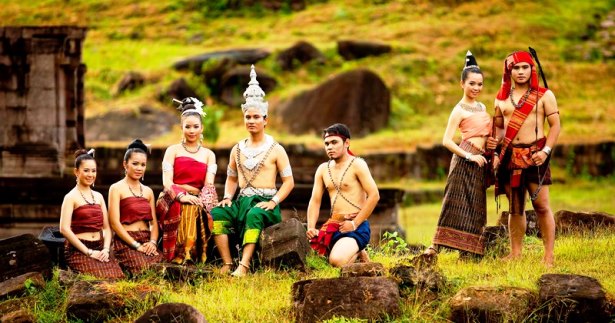
The annual Vat Phou Festival takes place in February each year, coinciding with the Buddhist festival of Makha Busa and bringing believers from near and far to attend a ceremony and take part in festivities. The Vat Phou Festival 2016 will take place on 03 February 2016.
Since the ancient Khmer ruins of Vat Phou were listed as a World Heritage Site by UNESCO, government authorities have been working hard to promote tourism in Champasak and the surrounding area. The Vat Phou Festival is also important for helping Lao people to understand the cultural significance and historical importance of the magnificent site.
Photos: Adul Tanthakosai
Alongside the sound and light show, the Vat Phou Festival will also include singing and dance performances by performers from Cambodia, Thailand and Vietnam as well as Laos. Most of the performers are local people from Champasak who have trained for the performance alongside their foreign counterparts. There will also be a large market for facilitating the sale of domestic products and handicrafts.
Vat Phou is open daily from 08:00 to 1800 and admission is around 30,000 kip. The Vat Phou complex is about 8 km from the main Champasak town, south of Pakse. For more information on ideas for a trip to the south of Laos, please contact us:info@asiarevealtour.com
Based on: Yingchockchai Group, Vientiane Mai
Photos: Adul Tanthakosai

Monday, July 27, 2015

Laos’ International Tourist Arrival Report 2014

Lao PDR’s Ministry of Information, Culture and Tourism reports international tourist arrivals surpassed 4.1 million in 2014, up 10.03% from 3.7 million in 2013.
The Vientiane Times quoted figures from the ministry that confirmed 2014 closed with 4,158,719 visitors compared to 3,779,490 in 2013.
According to the ministry’s Tourism Research and Administrative Division statistics, Thailand continue to supply the most foreign tourists .
Report 2014
However, Thai arrivals decreased 0.76% from 2,059,434 to 2,043,761 visits last year and the length of stay is short.
inside no 3Vietnam was second with 1,108,332 visits increasing 21.77% from 910,164 in 2013.
Laos also saw an increase in Chinese visitors from 245,033 in 2013 to 422,440 in 2014, up 72.40%. The percentage growth is high due to the relatively small numbers. As the volume expands the growth rate will lower to around 10 to 15%, but there is no doubt that within five years, China will be the top travel source market fo Laos with much higher revenue than either Thailand or Vietnam.
Europe was the only region that saw travel to Laos drop, due to an economic downturn in key markets. The region supplied 209,331 visitors in 2014 down 1.52% from 212,566 in 2013.
Tourists from ASEAN member countries increased 5.92% from 3.04 million in 2013 to 3.22 million visitors in 2014, while tourists from non-ASEAN states increased by 46.0% to 630,361 visits in 2014.
Visitors from the Americas increased by 0.15% to 86,027 in 2014, while tourists from Africa and the Middle East increased by 13% to 8,920 in last year.
Source:From report of TTRWeekly

Tuesday, July 21, 2015

Savannakhet at a glance

Total Area: 21,774 square kilometers.
Population: 906,440.
15 Districts: Kaisone Phomvihan, Outhoumphone, Atsaphangthong, Phine, Sepone, Nong, Thapangthong, Songkhone, Champhon, Xonnabouly, Xaybouly, Vilabouly, Atsaphone, Xayphouthong and Phalanxay.
Capital of the Province: Kaisone Phomvihan
Savannakhet Province is situated in the middle of the country and the largest province (21,774 square kilometers), being bordered by Vietnam to the East, Thailand to the West, Khammouane Province to the North and Salavanh Province to the South. 60% of land is covered by forests. A wide variety of ethnic groups are found in the province: Lowland Lao, Phoutai, Thai Dam, Katang, Mangkong, Vali, Lava, Soui, Kapo, Kaleung and Ta-Oi. In addition, many Vietnamese and Chinese descendants live in the province as well. This fact makes the province rich in cultural and gastronomic diversity.
Savannakhet has long been a center of trade and power. The province is well noted as the birthplace of the Honorable Kaisone Phomvihan, first Secretary of the Lao People’s Revolutionary Party and co-founder of the Lao PDR. His house and a museum documenting his life achievements can be visited in Savannakhet Town. The province’s history, however, goes back long before the time of man.
Savannakhet
The area was once inhabited by dinosaurs as evidenced by the bones found in Bang Tang Wai Village and the giant footprints found in Phalanxay, which are documented in the Savannakhet Dinosaur Museum. Remnants of an ancient civilization can be seen at the Stone temple, “Heuan Hin” a pre-Angkorian building located 40km down stream from town along the Mekong. That Ing Hang Stupa, originally built more than 1.000 years ago and later rebuilt by King Saysethathirath in the 16th century, is the province’s most important religious site. Also of interest is the historic library, Hortay Pidok, which is believed to have been built in the 18th century and was traditionally used to house old “Bai Lan” Buddhist scriptures. Of more recent history is the section of the Ho Chi Minh Trail which passes through Savannakhet. Old tanks, guns and other war equipment left behind on the trail can be seen near villages on Route 9 near the Vietnam border.The Phouthai ethnic group, known for its unique silk and cotton weaving, claimsits origin in the province’s Vilabouly District. The Katang ethnic group, which is loved for its famous folk song, Lam Tang Wai, also has traditional lands in Savannakhet. For nature enthusiasts, trekking in Dong Phou Vieng National Protected Area (NPA) provides an opportunity to see rare Douc and Silvered Langurs. Phou Xang Hae NPA has a population of wild elephants as well as distinctive rocky outcrops and vistas. The Eld’s deer, once considered to be extinct in Laos, were rediscovered in 2002 in Xonbouly District and are revered by local villagers. The Province is a hot spot for crocodiles, which inhabit the confluence of the Champhone and Xe Bang Hieng Rivers. Hundreds of stump-tailed macaques, considered sacred by locals, are easily spotted in the 4-hectare Monkey Forest. Giant Asian soft shelled turtles, also considered sacred, can be easily seen in Ban Done Daeng. In Dong Na Tad Provincial Forest, snakes, monkeys and old-growth forest are well protected by the villagers for spiritual reasons. Locally guided tours to the area are available.
Savannakhet is most noted for its weavings, especially Phouthai silk and cotton weaving in Vilabouly District, and ethnic Katang weaving in the Dong Phou Vieng area. The favorite national meat, “sin savanh”, a flat, sweet dried beef sprinkled with sesame seeds, originates from Savannakhet and can be purchased in local markets.
The That Ing Hang Festival is the largest festival of the year and is typically celebrated in December at the time of the full moon.
Source: www.tourismlaos.org

Wednesday, July 15, 2015

New destination - Xaysomboun Province

Xaysomboun province is set to officially open to tourists at the end of this year allowing visitors the chance to explore some unknown and untouched sites in this formerly secret area that was for a long time closed to all outsiders.
Xaysomboun Province was established on 13 December, 2013 as is the 18th Province of Laos. It is located in the central part of Laos, bordering Xiengkhouang Province to the North and the East, Bolikhamxay Province to the South and Vientiane Province to the West. The Province consists of 5 districts which include Anouvong, Long Cheng, Long San, Hom and Tha Thom District. This province does not share any borders with neighboring countries.
To reach this province, there are to ways:
Follow Route 13 to the North of Vientiane – Vang Vieng, about 140 km
Follow Route 13 to the South of Vientiane – Paksan about 90 km

Xaysomboun Province has abundant natural resources scattered in high mountains and steep valleys. The province has a fresh air and cool breeze during summer, but getting pretty cold during winter – some years it gets down below zero degrees. In general,  the annual average temperature of approximately 20˚C.
With a total population of around 80,000; consisting of Khamu 19%, Hmong 55% and Laoloum 26%, this province has rich culture and tradition coupled with generous hospitality of local people.
Visit Xaysomboun, tourists could choose between enjoying home-stay with several ethnic groups, or staying at standard four star hotel. A number of largely unexplored historic caves and mountains is also the attractive of this potential area.
Firstly, exploring Phou Mork in Long Cheng District, learn more about King Anouvong. Then embark on a local boat, seeing the stunning view of Tha Thom District, have a yummy feast at Dan Pha Saeb, Long San, and experience the legend of Chae Lae Waterfall in Hom District. For those are the faithful of adventure, climb to the top of Phou Bia – the Roof of Laos PDR, will be one of the most unforgettable memory.